
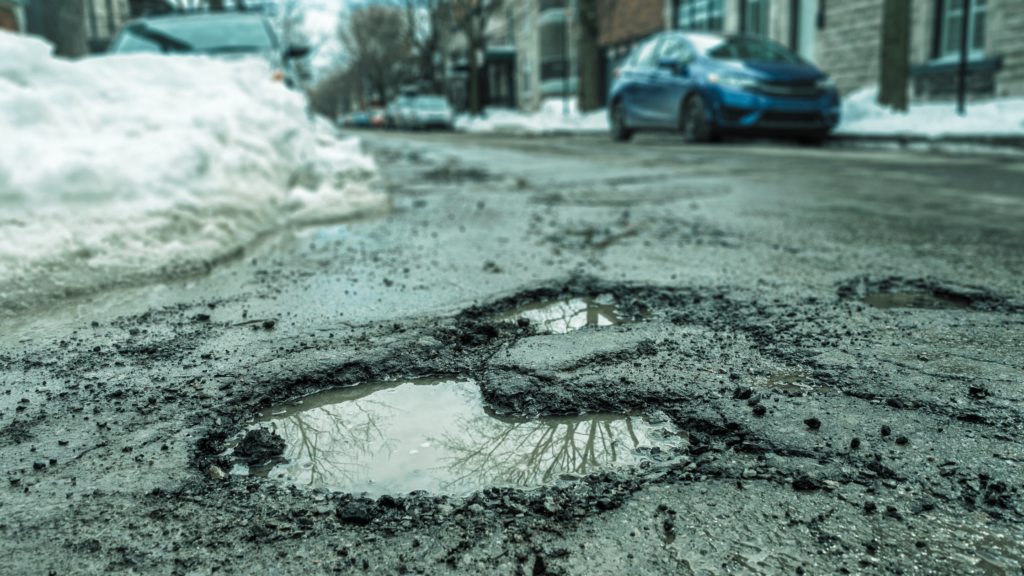
Take a moment to form a mental image of the harm that climate change is causing in BC. If any image or memory comes to mind, I’m guessing it’s a big disaster: a wildfire, flooding, or perhaps the excruciating heat of the 2021 heat dome. I’m guessing that, but for the title of this piece, you would not have thought of the pothole down the street or local roadwork as your community replaces a storm drainpipe. However, the reality is that governments across Canada are spending almost an extra $9 billion a year on harm to basic infrastructure because of climate change.
As a recent report by the Canadian Climate Institute (CCI), Prepare or Repair, explains:
One of the most striking consequences of climate change is the impact on the public infrastructure that was built for a climate that no longer exists. Roads buckle in the heat, storm sewers overflow during heavy rains, and water treatment systems struggle to maintain safe supplies during droughts and contamination events. (p. 1)
For the purposes of the Sue Big Oil campaign this report is incredibly useful in helping to explain the many ways in which climate change from fossil fuel pollution is harming our communities. Prepare or Repair could also be valuable evidence for courts quantifying how much those companies should be ordered to pay our local governments.
Calculating how climate change is driving Canadian infrastructure costs
As CCI explains, Canadian infrastructure – “roads, bridges and culverts, public buildings, and wastewater and stormwater systems” – are all designed and built with a particular range of normal weather in mind. It usually doesn’t make sense for a city to build a storm drain that can accommodate a one in a thousand-year rain event; it costs a lot more to do so, and that event is unlikely to occur during the 50+ year lifetime of the infrastructure.
But climate change means that an event that was previously expected every millennium is now occurring much more frequently. And more frequent and intense storms – even if they don’t overwhelm the system – mean more wear and tear on the stormwater system.
Prepare or Repair concludes that wear and tear from climate change is already costing Canadian governments more than $8.8 billion per year just for day-to-day maintenance and replacement of existing public infrastructure that doesn’t last as long as expected – an amount that is rising. As we’ll discuss below, this amount is almost certainly an underestimate of the true costs of climate change for governments, as the report’s methodology doesn’t actually include all public infrastructure, climate-related government services, the costs of replacing infrastructure destroyed by climate disasters or of building new infrastructure.
The CCI began by looking at Statistics Canada data on the location and status of public infrastructure. Even without the costs of climate change, the researchers found that governments are struggling to keep up with repairing this vast network of systems, with about 14% of infrastructure in Canada in poor or very poor condition. Systems that are in poor condition are also more vulnerable to future climate disasters.
Canada’s infrastructure deficit is more than a fiscal problem — it is a climate-risk multiplier. Aging systems are less efficient, more vulnerable to extreme weather, and more expensive to repair after failure. Each new flood, heat wave, or freeze-thaw cycle accelerates deterioration and adds to deferred costs. (p. 4)
Local governments, in particular, own more than 60% of public infrastructure but have relatively few options (compared to the provincial and federal governments) to raise funds to maintain it. The problem is even more acute for rural communities – which have infrastructure spread over a larger area with a lower population to support it.
The researchers then estimated the expected impact of increased heat and precipitation due to climate change on that infrastructure, using “climate-driven infrastructure deterioration models” that estimate the increase in deterioration of infrastructure associated with projected temperature or precipitation increase:
To connect these physical effects to financial outcomes, the analysis uses coefficients that quantify how responsive different infrastructure costs are to changes in climate variables. For example, a 1°C increase in average temperature or a 10 per cent rise in annual precipitation translates into a corresponding percentage change in maintenance or replacement costs for a certain type of infrastructure. (p. 9)
Based on these calculations, Prepare or Repair found that, if infrastructure is managed as usual, climate change is expected to add an average of $15.1 billion per year to maintenance costs between now and 2100, growing from $8.8 billion now to $14.3 billion by 2050 and $19.4 billion by 2100. For comparison, the 2016 climate-fueled wildfire that destroyed most of Fort McMurray was a one-time event that caused approximately $9 billion in damages.
About 72% of the infrastructure costs documented by Prepare or Repair are associated with local government infrastructure.
Even without climate change, the costs of maintaining Canada’s $2.7 trillion of public infrastructure is $112 billion per year on average, so climate change increases the costs of infrastructure in the country by about 12% – a big blow to governments already struggling to maintain systems and services without increasing taxes.
A stitch in time saves taxpayers a tonne of money
A central message of Prepare or Repair is in the report’s title: we have a choice between preparing our infrastructure for climate change or spending even more money repairing it when it crumbles as a result of climate change. And it turns out that preparation is initially a bit more expensive, but much, much cheaper in the long run.
The report considers three possible ways that governments can respond to climate change’s impacts on infrastructure:
- Under a No Adaptation scenario “assets continue to be replaced to today’s standards, leaving them fully exposed to increasing climate stress.”
- With Reactive Adaptation “assets are upgraded to be climate-resilient only at the time of replacement.”
- And finally, with Proactive Adaptation “upgrades occur at the earliest opportunity—either during major rehabilitation or at the point of full replacement.”
The analysis shows that preparing infrastructure for climate change is much cheaper than doing nothing, with the reduced infrastructure costs more than paying for the initial upfront costs:
The message is clear: adapting public infrastructure proactively isn’t just an expense—it’s a smart investment. Acting now will save billions in future losses, while also protecting essential services and strengthening communities across the country. Waiting will only drive costs higher. Investing in infrastructure resilience today means a safer, more prosperous Canada tomorrow. (p. 2)
As the chart below shows, proactive adaptation – investing in the most climate vulnerable infrastructure – starts saving money almost at once, but it does require governments to be proactive and spend the money to upgrade their roads, storm drains, buildings and other infrastructure. According to the report, “proactive adaptation to the climate threats considered in this study … requires investment of approximately $1.4 billion annually beginning immediately, with an average annual investment of $3 billion over the remainder of the century.” (p. 20)
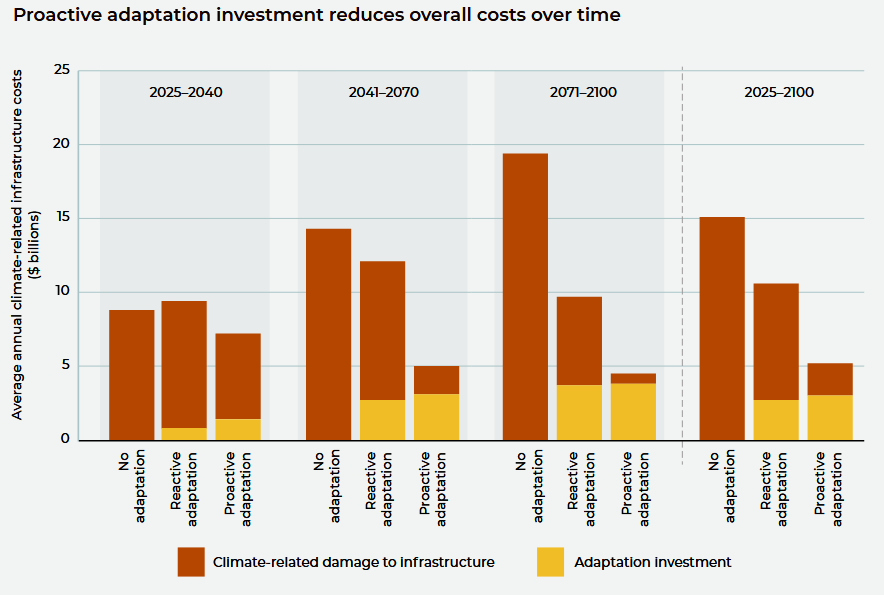
However, between 2025 and 2100, this approach will save an average of $9.9 billion per year, making our infrastructure much safer, much more quickly:
Under a proactive approach, over 70 per cent of public assets could be brought to climate-resilient standards by the 2050s, compared to about 30 per cent under a reactive strategy. By the 2080s, only a small share of assets would remain highly exposed to climate risks with a proactive approach, whereas reactive adaptation would leave nearly half still vulnerable to worsening impacts, high-consequence events, and sudden fiscal shocks to government infrastructure owners. (p. 19)
Climate costs will be even higher than estimated
While Prepare or Repair is extremely helpful in attaching a dollar value to real costs that otherwise might be invisible, it is important to understand the limits of this excellent report and the fact that – as its authors readily acknowledge – it only examines a fraction of potential community climate costs.
Because of the available data and technical methodology, Prepare or Repair focuses only on the effect of heat and precipitation on maintenance and replacement of certain types of existing infrastructure.
Even in relation to infrastructure, the overall costs identified in the report do not include:
- Maintenance of other types of infrastructure – Urban forests and other natural infrastructure, as well as existing dikes and flood prevention measures, are among the infrastructure not included in the database assembled for the Report (although there is a brief discussion of flood prevention on p. 22).
- Construction, and subsequent maintenance, of new infrastructure to protect residents – Misting stations and other heat protection infrastructure, or entirely new dikes or flood prevention measures, are not included.
- The impact of disastrous climate events on infrastructure – Because it’s impossible to predict precisely in advance where wildfires, landslides or many other impacts of climate change will hit, the report does not include the costs of rebuilding infrastructure after those types of events.
Also not included are government costs not directly related to infrastructure, such as services intended to keep residents safe from climate impacts. Governments have had to increase funding for emergency planning, wildfire mitigation and fighting, ensuring that cooling centres are open during heat waves, and provide other services, at considerable costs to taxpayers.
More fundamentally, the focus on public infrastructure costs means that the impacts to homeowners and private businesses of both climate change and of the failure of public infrastructure are not fully evaluated:
Households ultimately bear both the direct and indirect consequences of deteriorating public infrastructure. When critical systems such as roads, bridges, and water networks fail, service disruptions affect people’s employment, mobility, health, and safety. The impacts also flow through higher taxes, user fees, and cuts to services, as governments recover the rising costs of damage and repair. Failures of public infrastructure can also trigger private property damage—for example, through flooded basements or extended power outages—creating financial strain and uncertainty for affected households and putting claim cost pressure on insurance premiums.(p. 26)
The failure to include these types of climate costs is not a criticism of Prepare or Repair; this research did a fantastic job in estimating the regular costs associated with changes in temperature and precipitation on certain types of infrastructure and the authors repeatedly acknowledge the limits of the report. However, it is clear that the actual costs that governments, as well as the citizens of Canada, are experiencing due to climate change are much, much higher.
Prepare or Repair shows why we need to Sue Big Oil
Prepare or Repair does not directly discuss the possibility of our communities suing fossil fuel companies to recover the costs of climate change. However, it does lay the groundwork for that conversation by quantifying for the public how much climate change – primarily caused by the burning of fossil fuels – is driving up the cost of maintaining our roads, water systems and public buildings.
Once someone understands that we are spending money because of climate change, the question of who should pay for it becomes inevitable. From there it’s not a big leap to connect the massive profits that fossil fuel companies make selling the products that cause climate change with the costs we now face. This is particularly true when you realize the considerable lengths that fossil fuel companies have gone to keep people from moving to cleaner alternatives. The real question is what their fair share of these costs are – not whether they should be paying anything at all.
The Prepare or Repair methodology also provides a technical methodology that may be useful for the local governments that eventually file the lawsuit against fossil fuel companies. While local government staff will often acknowledge that climate change is increasing their infrastructure costs, they usually don’t know by how much, what future costs they should be planning for or how to calculate them.
Municipal governments could use the approach developed by the authors of Prepare or Repair to analyze their infrastructure, getting a local, and likely more accurate (since they will have more detailed information on their infrastructure) figure of how much they should be spending to maintain existing infrastructure, and how much they might save if they were to upgrade that infrastructure to make it more climate resilient.
Exceptional storms, floods and wildfires are just the visible tip of the climate costs iceberg. Far more invisible, probably more costly, and more universally felt are the day-to-day costs resulting from more modest, but frequent, changes in heat and precipitation. And thanks to Prepare or Repair, we finally have a way to quantify those costs – and perhaps hold those responsible to account.
Written by Andrew Gage, Staff Lawyer, West Coast Environmental Law